
Cremation Flue Gas Emission Standards: A Global Guide
Introduction
Cremation flue gas emission standards set the maximum concentration of particulate matter, carbon monoxide, nitrogen oxides, acid gases, mercury, and dioxins that a cremator may release to atmosphere. There is no single global rulebook — the cremation flue gas emission standards that apply depend on where the unit is installed, and the differences are wide enough to change how a furnace is designed, abated, and monitored.
For manufacturers selling into Europe and North America, the essential positions are these. The UK requires 10 mg/Nm³ particulate for existing abated cremators and 5 mg/Nm³ for new ones, mercury at 30–50 µg/Nm³, and NOx at 200 mg/Nm³ phasing in from 2027. Germany caps dust at 10 mg/Nm³ and dioxins at 0.1 ng/Nm³ but leaves mercury to permit conditions. The European Union’s Industrial Emissions Directive supplies the benchmark that national rules are written against, though it does not govern crematoria directly. The United States has no federal crematory emission standard at all and relies on state and local air permits. China and India matter chiefly as export destinations.
This guide is written for cremator manufacturers, environmental regulators, and funeral-industry operators who need to compare requirements fairly and design equipment that passes inspection in more than one market.
What Cremation Flue Gas Contains
Human cremation runs roughly 50 to 120 minutes per cycle, and its exhaust profile differs from that of a conventional industrial boiler or waste incinerator. The regulated pollutant set is consistent across jurisdictions, but each constituent behaves differently.
- Particulate matter — fine ash, soot, and incompletely oxidised char.
- Carbon monoxide — the standard indicator of combustion efficiency.
- Nitrogen oxides — thermal NOx, plus fuel-bound nitrogen.
- Acid gases — hydrogen chloride, sulphur dioxide, and hydrogen fluoride, largely from coffin veneers and plastics.
- Mercury — volatilised from dental amalgam, typically 0.1–2 g per set of restorations.
- Dioxins and furans (PCDD/F) — unintentionally formed in the 200–450 °C post-combustion window.
- Volatile organic compounds and total organic carbon — products of incomplete combustion.
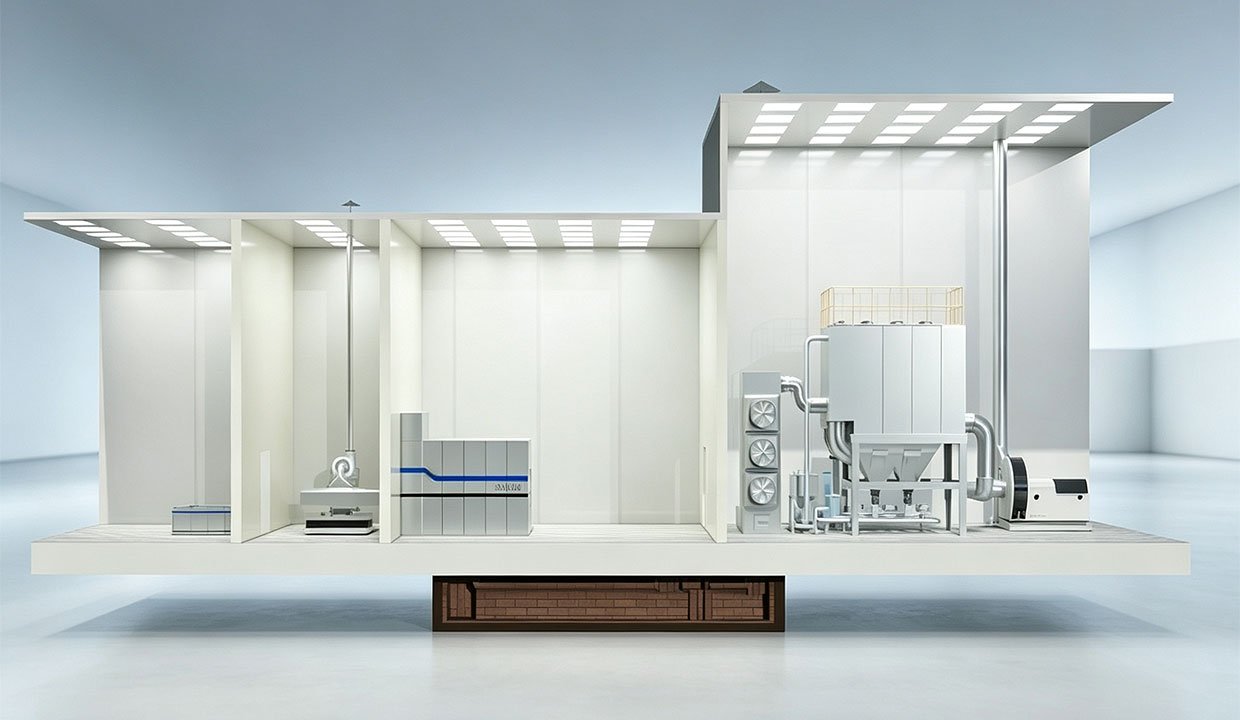
Because these pollutants form in different temperature windows and under different conditions, no single abatement device addresses all of them. That is why national standards regulate the same pollutant set at quite different numerical ceilings — and why a compliant installation almost always combines combustion control with a multi-stage flue gas train.
How Cremation Flue Gas Emission Standards Are Structured
Not all limits are equivalent. A regulation can look stricter than another simply because it uses a different averaging period or oxygen reference, so any fair comparison has to normalise for both.
Concentration versus mass limits. Most standards express limits in mg/Nm³. Some, notably the UK, also allow a mass-based limit in grams per hour per cremator. Where both exist, the operator chooses which to meet and the regulator writes that choice into the permit.
Oxygen reference. Limits are meaningless without a declared O₂ baseline. The EU directive standardises values at 11% oxygen, dry gas, and UK crematoria guidance uses the same reference. A limit quoted at 11% O₂ is not directly comparable to one quoted at 6% or with no correction at all.
Averaging periods. The EU uses daily, half-hourly, and 10-minute averages for different pollutants; UK guidance averages over three 60-minute periods. Short-term averages drive control-system design, while long-term averages drive annual reporting and enforcement.
Combustion conditions as regulatory requirements. Many standards do not stop at stack concentrations. UK guidance requires a secondary chamber at a minimum of 850 °C for unabated cremators (800 °C with flue gas treatment fitted, rising to 850 °C if abatement fails), a residence time of at least 2 seconds, and 6% oxygen at chamber exit, with CO held below 100 mg/Nm³ as a target. Germany’s 27th BImSchV likewise mandates continuous recording of CO, O₂, flue-gas density, and minimum chamber temperature.
Cremation Flue Gas Emission Standards in Europe and North America
European Union: the IED as a de facto benchmark
The Industrial Emissions Directive (Directive 2010/75/EU, Annex VI) governs waste incineration. Its daily average limits include dust 10 mg/Nm³, TOC 10, HCl 10, SO₂ 50, NOx 200, mercury 0.05, other heavy metals 0.5 mg/Nm³ combined, CO 50 mg/Nm³, and PCDD/F 0.1 ng/Nm³ — all referenced to 11% oxygen.
The nuance that matters commercially is this: human remains are not classified as waste, so cremation sits outside the directive’s waste-incineration chapter in most member states and crematoria are regulated nationally. Annex VI is nonetheless the benchmark those national rules are written against — which is why the same 10 mg/Nm³ dust and 0.1 ng/Nm³ dioxin figures recur across European permits. For any specific project, treat the member-state rule and the site permit, not the directive text, as the binding specification.
United Kingdom: PG5/2 separates abated from unabated cremators
UK crematoria are regulated under local air pollution prevention and control, guided by Process Guidance Note 5/2, which separates cremators with flue gas treatment from those without.
For abated cremators, the emission limit values are, in mg/Nm³ unless stated: particulate matter 10 existing and 5 new; HCl 30 existing and 20 new; TOC 20 existing and 10 new; NOx 200; PCDD/F 0.1 ng/Nm³; and mercury 50 µg/Nm³ existing and 30 µg/Nm³ new. The NOx limit is phased — the draft (PG5/2(23)) applies it from 1 January 2027.
For unabated cremators, guidance sets mass-based limits instead: 120 g per hour for 95% of cremations and 240 g per hour maximum for particulate matter, and 300 g per hour for HCl, plus the combustion conditions set out above. Operators must also manage dilution air, fit cremulator filtration with continuous filter-failure detection, and assess local air quality using dispersion modelling or the Environment Agency’s H1 screening tool.
A further regional instrument worth knowing is OSPAR Recommendation 2003/4, which addresses the dispersal of mercury from crematoria in the North-East Atlantic area and has shaped UK mercury policy for the past two decades.
Germany: 27th BImSchV and a permit-driven mercury regime
Germany regulates cremation under the 27th Ordinance for the Implementation of the Federal Immission Control Act (27th BImSchV), issued in March 1997 and amended in 2013 — among the earliest dedicated cremation emission ordinances anywhere.
It sets hourly limits for CO, total carbon, total dust, and PCDD/F, and requires continuous measurement of CO, oxygen, and flue-gas density plus recording of the minimum secondary-chamber temperature. Notably, the ordinance contains no mercury limit value. Instead, licensing authorities impose mercury abatement as a permit condition, and national inventory reporting puts effective mercury mitigation at roughly 90% of German plants (UBA). A 2024 Bavarian Environment Agency study (LfU Bayern) found some installations still exceeding the 50 mg/m³ CO limit, and flagged mercury, NOx, HCl, and formaldehyde as pollutants the ordinance does not regulate at all.
United States: no federal crematory standard
When the EPA finalised its Other Solid Waste Incineration rules it concluded that the human body is not “solid waste”, so human crematories are not solid waste incineration units — a position the agency restated when it denied a petition for reconsideration (72 FR 36605). There is no federal NSPS or emission guideline for human crematories.
Regulation therefore sits with state and local air agencies, and stringency varies considerably from one district to the next. Permit conditions commonly include opacity caps of 10–20% on a six-minute average verified under EPA Method 9; CO limits around 100 ppm; dioxin limits in the low nanograms per cubic metre in several states; and mercury limits or abatement requirements in some jurisdictions. Federal jurisdiction does not vanish entirely — a crematory crossing major-source thresholds becomes subject to Title V permitting, and civil penalties exceed $120,000 per day.
Cremation Flue Gas Emission Standards in Asia and Emerging Markets
China: GB 13801-2015 sets a single numeric national standard
China is the most prescriptive major market. The Crematorium Air Pollutant Emission Standard (GB 13801-2015) applies a single national numeric standard to all funeral parlours, and it is enforced through project-level environmental impact assessment.
New projects face particulate matter 30 mg/m³, SO₂ 30, NOx 200, CO 150, HCl 30, mercury 0.1 mg/m³, PCDD/F 0.5 ng-TEQ/m³, and Ringelmann grade 1. Existing projects face looser values — particulate matter 80, SO₂ 60, NOx 300, CO 300 mg/m³, PCDD/F 1.0 ng-TEQ/m³ — with HCl and mercury omitted. These figures are reproduced verbatim in municipal EIA approvals (example EIA approval), which is why the standard functions as the effective procurement gate for new cremation lines.
Two consequences follow for anyone selling into China. The 0.1 mg/m³ mercury limit makes activated-carbon injection effectively mandatory on new lines. And compliant flue-gas trains follow a consistent sequence: quench, semi-dry deacidification, cyclone, bag filter, activated-carbon adsorption, and a stack of at least 15 m. For a foreign bidder, procurement is driven by EIA approval, so a bid must include a documented abatement sequence and a secondary-chamber design basis — not merely a unit that complies on paper. Chinese regulators have stated that no “ultra-low emission” standard for the funeral sector is currently planned, so GB 13801-2015 remains the governing benchmark for the foreseeable future.
India, Japan, and markets with no single national limit
India has no dedicated numeric emission standard for human crematoria. Where air pollution control has been retrofitted — such as the CSIR-NEERI “green crematoria” system at Nigam Bodh Ghat in Delhi — compliance is assessed against CPCB general emission standards under PCLS/4/2000-2001 (CSIR-NEERI). For incineration-based treatment, the Biomedical Waste Management Rules 2016 provide a useful reference set: particulate matter 50 mg/Nm³, NOx 400, HCl 50, mercury 0.05 mg/Nm³, and PCDD/F 0.1 ng-TEQ/Nm³.
Japan regulates cremation through municipal ordinances and JIS performance standards, with an emphasis on combustion quality rather than a single national stack ceiling. Australia relies on state permits that prioritise opacity and stack dispersion over a national numeric limit. In both cases the practical effect for exporters is the same as in the United States: the site permit, not the national framework, is the specification that must be satisfied.
Comparison Table: Cremation Flue Gas Emission Limits by Jurisdiction
| Jurisdiction | Instrument | PM | CO | NOx | HCl | Hg | PCDD/F |
| EU (benchmark) | IED 2010/75/EU, Annex VI | 10 mg/Nm³ | 50 mg/Nm³ daily | 200 mg/Nm³ | 10 mg/Nm³ | 0.05 mg/Nm³ | 0.1 ng/Nm³ |
| UK (abated) | PG5/2 | 10 existing / 5 new mg/Nm³ | <100 mg/Nm³ target | 200 mg/Nm³, phased | 30 existing / 20 new mg/Nm³ | 50 existing / 30 new µg/Nm³ | 0.1 ng/Nm³ |
| UK (unabated) | PG5/2 | 120 g/h covering 95% of cremations; 240 g/h max | <100 mg/Nm³ target | Report only | 300 g/h | Report only | Annual monitoring |
| Germany | 27. BImSchV | Hourly limit in ordinance | Hourly limit in ordinance | Not covered | Not covered | Not capped; permit conditions | Hourly limit in ordinance |
| United States | State and local permits | Opacity 10–20%, 6-minute average | ~100 ppm | Case by case | Case by case | Some jurisdictions only | Low ng/Nm³ in several states |
| China (new) | GB 13801-2015 | 30 mg/m³ | 150 mg/m³ | 200 mg/m³ | 30 mg/m³ | 0.1 mg/m³ | 0.5 ng-TEQ/m³ |
| China (existing) | GB 13801-2015 | 80 mg/m³ | 300 mg/m³ | 300 mg/m³ | — | — | 1.0 ng-TEQ/m³ |
| India (reference) | CPCB PCLS/4/2000-2001 | 50 mg/Nm³ | Monitored | 400 mg/Nm³ | 50 mg/Nm³ | 0.05 mg/Nm³ | 0.1 ng-TEQ/Nm³ |
Values are mg/Nm³ unless a unit is stated, at each instrument’s declared oxygen reference (11% O₂ for the EU and UK). These are indicative figures — confirm against the current instrument and the site permit before design or procurement.
Compliance Guidance for Cremator Manufacturers and Operators
Three cost drivers dominate European and North American specifications: mercury abatement, NOx abatement, and continuous monitoring. The following practices recur across every regime reviewed above.
- Resolve the permitting route before you design the furnace. In the United States that means identifying state or district rules and whether the facility crosses a Title V threshold; in the UK, confirming whether the installation will be treated as abated or unabated; in the EU, reading the member state’s national rule rather than assuming the directive applies. The permitting route determines the design basis.
- Confirm abated versus unabated status early. The UK’s two regimes carry entirely different limit structures, and the choice affects abatement specification, monitoring obligations, and cost. Establishing this at tender stage prevents a redesign after the furnace is ordered.
- Design the abatement train around the strictest plausible target. A train of quench cooling, dry sorbent or lime injection, activated-carbon injection, and bag filtration addresses acid gases, mercury, dioxins, and particulate in one pass — exactly the sequence required in practice by Chinese EIA approvals and recommended in UK best-available-technique guidance. Retrofitting mercury capture later costs far more than specifying it upfront.
- Treat the secondary combustion chamber as the primary compliance device. Achieve and document at least 850 °C with 2 seconds’ residence time and 6% oxygen at exit. Most CO and dioxin exceedances trace back to chamber geometry, changes made during re-bricking, or charge timing rather than to the filter.
- Fix the oxygen reference in every test report. Reporting an uncorrected concentration against an 11% O₂ limit is a frequent source of apparent non-compliance. Record O₂, temperature, and moisture simultaneously with every measurement.
- Plan the monitoring regime with the permit, not after it. CEMS for CO and O₂, opacity monitoring, continuous filter-failure detection on cremulators, and periodic dioxin campaigns on a 6–8 hour sampling basis each have different hardware and stack-access requirements. Where NOx abatement is installed, selective non-catalytic reduction introduces ammonia slip — which triggers an ammonia measurement obligation in UK guidance and increasingly in European permits.
- Build the stack and dispersion case early. Stack height and efflux velocity determine whether a project passes local air-quality screening. UK guidance sets a clear screen-out test — short-term process contribution below 10% and long-term below 1% of the relevant environmental standard — and comparable screening logic appears in Chinese EIA approvals.
- Keep documentation export-ready, and budget for periodic verification. Buyers in regulated markets ask for the design basis of the secondary chamber, abatement component specifications, and reference measurement reports; one technical dossier covering the EU, UK, and GB 13801-2015 limit sets shortens procurement and pre-shipment inspection considerably. Note also that dioxin monitoring frequency typically rises to annual where flue gas treatment is fitted, and that monthly or four-weekly combustion-parameter reporting is a standing obligation in the UK regime.
Two moving parts are worth tracking. The UK NOx limit is still phasing in, some Chinese provinces are pushing voluntary ultra-low targets ahead of any national revision, and OSPAR-driven mercury expectations continue to influence European permit conditions. A standard that is compliant today may require an abatement upgrade within one permit cycle.
Frequently Asked Questions
Is there a federal cremation emission standard in the United States? No. The EPA determined that human remains are not solid waste, so human crematories fall outside the Other Solid Waste Incineration rules. Requirements come from state and local permits, though Title V obligations can apply above major-source thresholds.
Which country has the strictest cremator emission limits? It depends on the pollutant. Germany and the UK set the tightest particulate limits for new abated cremators (5–10 mg/Nm³) and both target 0.1 ng/Nm³ for dioxins. The EU’s Annex VI provides the strictest broadly applied benchmark set, though it does not directly govern crematoria. Outside Europe, China is strictest on mercury.
What is the dioxin limit for cremators? The most common reference value is 0.1 ng/Nm³ as TEQ, used by the EU, UK, and German regimes. China’s GB 13801-2015 sets 0.5 ng-TEQ/m³ for new lines and 1.0 ng-TEQ/m³ for existing lines.
How is mercury controlled in cremation flue gas? Mercury from dental amalgam volatilises during combustion. Effective control relies on activated-carbon injection with bag filtration, typically achieving 90–98% removal. Where no national limit exists — as in Germany’s 27th BImSchV — control is imposed as a permit condition instead, so mercury abatement should be specified as standard rather than treated as an optional extra.
How often must a cremator be monitored and tested? It depends on the permit, but the pattern is consistent. Continuous monitors run for CO and O₂, opacity or flue-gas density is monitored continuously, and filter-failure detection is continuous on cremulators. Periodic dioxin sampling typically moves to an annual cycle where flue gas treatment is fitted, and combustion-parameter reporting runs monthly or every four weeks under the UK regime.
Conclusion
Cremation flue gas emission standards converge on the same pollutant list but diverge sharply on legal architecture. Europe benchmarks against the IED while regulating crematoria nationally; the UK splits abated from unabated cremators and phases in NOx; Germany’s 27th BImSchV is comprehensive on dioxins and combustion conditions but silent on mercury; and the United States leaves everything to state and local permits.
For manufacturers selling into Europe and North America, the binding specification is a permit, not a directive or a statute. Design to the strictest plausible permit rather than the loosest published rule, then document the package once for every market you intend to serve. That approach turns cremation flue gas emission standards from a barrier at each border into a single engineering specification.
Sources
- European Union, Directive 2010/75/EU (Industrial Emissions Directive), Annex VI, 24 November 2010.
- UK Government, Crematoria: emissions limits, monitoring and other provisions.
- Defra, Draft Crematoria Guidance PG5/2(23), consultation draft.
- German Federal Environment Agency (UBA), Informative Inventory Report — Cremation (NFR 5.C.1.b.v).
- Bavarian Environment Agency (LfU Bayern), Emissionsmessung und Optimierungspotential an bayerischen Krematorien, 2024.
- US EPA, Final rule and denial of reconsideration on human crematories, 72 FR 36605, 5 July 2007.
- People’s Republic of China, Crematorium Air Pollutant Emission Standard (GB 13801-2015), Tables 2 and 3.
- Anhui Provincial Department of Ecology and Environment, reply on funeral-sector emission standards, 2020.
- CPCB, Guidelines for Management of Healthcare Waste, Schedule II incineration standards, 2018.
- CSIR-NEERI, Air Pollution Control in Green Crematoria, Delhi, 2021.
- OSPAR Recommendation 2003/4 on controlling the dispersal of mercury from crematoria.