Dignity. Technology. Sustainability. — Redefining the Afterlife Industry.
Dignity. Technology. Sustainability. — Redefining the Afterlife Industry.
Mortuary Refrigeration Temperature Guide: What You Need to Know
Mortuary refrigeration temperature should be maintained at 2–4 °C (36–39 °F) for short-term body storage, and −18 °C (−0.4 °F) or below when preservation is expected to last more than roughly 30 days. These two figures—the chilled band and the frozen band—determine whether a facility is operating within accepted practice or drifting toward a compliance and preservation failure. Everything else in this guide exists to keep those numbers stable and provable.
Below we cover the compliant ranges in detail, the regulations that set them, how to choose between equipment types, how to monitor and document temperature, how to respond when it drifts, and the maintenance routine that prevents most failures in the first place.
Why Temperature Control Matters More Than Most Operators Think
Body storage temperature is not simply a comfort or dignity question. It is a decomposition-control threshold, an infection-control control point, and in many jurisdictions a licensed condition of operation.
Three separate pressures converge on the same number:
- Preservation. Above roughly 4 °C, autolysis and bacterial activity accelerate, and visible and olfactory deterioration speeds up. The clock is not linear — the difference between 2 °C and 8 °C is measured in days of usable presentation time, not degrees.
- Regulatory. Several jurisdictions set a hard ceiling and inspect against it. Virginia, for example, requires that a body held more than 48 hours be either refrigerated to approximately 40 °F (4.4 °C) or less, or embalmed (§ 54.1-2811.1). A facility that cannot evidence its hold temperature is non-compliant even if the actual temperature was fine.
- Public health and staff safety. Refrigeration slows but does not sterilise. Handling practice, personal protective equipment and surface decontamination remain necessary regardless of the set point — see the WHO interim guidance referenced in the External Link Plan.
The practical consequence: the set point, the monitoring record, and the response procedure are a single system. If two of the three fail, it won’t pass an inspection or protect a reputation.
Recommended Temperature Ranges
Short-Term Storage: 2–4 °C (36–39 °F)
The widely accepted short-term band for body storage is 2–4 °C (36–39 °F). Variants appear in the literature — some sources express the same intent as 34–38 °F, others as 36–40 °F — and the practical read-across is a target of roughly 3 °C (about 37 °F) with excursions contained inside the band.
The 40 °F (4.4 °C) ceiling is the single most useful operational line to memorise. It is the point at which US state requirements typically bottom out, and it is the threshold most alarm systems are configured to catch. A cooler that idles between 38 °F and 39.5 °F is normal. A cooler that peaks at 41 °F overnight is an event that needs a documented response.
Where a facility has a viewing or chapel-ardente area—an unrefrigerated or lightly cooled visitation space—that is a separate space with a separate specification, commonly in the 8–10 °C (46–50 °F) region, and should not be confused with body storage. Mixing the two set points in one control strategy is a common and avoidable error.
Long-Term Preservation: −18 °C (−0.4 °F) and Below
When a body must be held beyond the normal storage window — pending legal process, delayed burial arrangements, or indefinite identification holds — the storage mode shifts from refrigeration to freezing.
- UK Human Tissue Authority (HTA) licensed establishments guidance (updated September 2025) states that where bodies are to be kept for more than 30 days, and there is no immediate need for release or examination, they should be frozen rather than refrigerated, with freezing at approximately −20 °C.
- Equipment designed for coronial and forensic retention typically specifies −15 °C to −20 °C for long-term law-enforcement or medical-examiner holds.
- A broader range of −10 °C to −50 °C is quoted depending on the required retention duration and the governing authority — a note that the “correct” number is jurisdiction- and purpose-dependent, not universal.
The critical operational point is that refrigeration and freezing are different regimes, with different equipment, utility loads, and paperwork. A facility that freezes occasionally should confirm its compressor, insulation, and defrost strategy are rated for continuous sub-zero duty before accepting its first long-term hold.
The Transition Rule
HTA guidance is explicit on the handover point: bodies refrigerated for more than 30 days, with no requirement for immediate release or examination, should be moved into frozen storage. Treating “30 days” as a soft trigger rather than a deadline is a recurring audit finding. Build it into the storage log as a mandatory review checkpoint.
Industry Standards and Compliance Requirements
No single global standard exists for mortuary refrigeration temperature. What exists is a patchwork of national guidance, sub-national regulation and professional practice. Operators should identify which instruments actually bind them, then work backwards to a set point.
| Instrument | Jurisdiction/scope | Temperature or duration requirement |
| Human Tissue Authority (HTA) licensing standards (updated Sept 2025) | England, Wales, N. Ireland — licensed establishments | Refrigerated storage approx. 4 °C; freezing approx. −20 °C; transfer to frozen storage after 30 days where no release/examination is needed |
| HSE HSG283 (Managing infection risks when handling the deceased), published July 2018, ISBN 978-0-7176-6676-8 | Great Britain — occupational safety guidance | Covers safe handling, storage, examination and associated infection risk; sets the framework rather than a single set point |
| NSW Public Health Regulation 2022 (s.80; NSW Health page updated 10 Nov 2022) | New South Wales, Australia | Approval to extend storage requires evidence of storage at 2–5 °C; after refrigeration, no more than 8 hours may elapse at non-refrigerated temperature; at 2–5 °C an extension of 7 or 28 days applies, and embalmed remains may be held beyond 28 days |
| Virginia Code § 54.1-2811.1 | Virginia, USA | Body held >48 hours must be refrigerated to approx. ≤40 °F (4.4 °C) or embalmed |
| CDC guidance (decedent care) | USA — federal guidance, adopted into state frameworks | Where embalming is delayed, refrigeration to ≤40 °F is advised |
| WHO / PAHO interim guidance on decedent management (COVID-19, March 2020) | International | Standard precautions, PPE, safe packaging and transport of remains; confirms that, apart from haemorrhagic fevers and cholera, bodies are generally not infectious |
| OSHA 29 CFR 1910.1030 (Bloodborne Pathogens) | USA — employer duty | Relevant to staff handling remains, waste and contaminated surfaces; supports the PPE and exposure-control requirements around storage rooms |
| EPA Section 608 (refrigerant handling) | USA | Certification requirement relevant to refrigerant handling; most facilities contract this out |
Reading the table correctly: the 40 °F / 4.4 °C line, the 2–5 °C line, and the ~4 °C line are all describing the same operational reality with different precision. The variance is not a contradiction — it is the difference between a statutory ceiling, a licensing expectation, and a guideline target. Set your controller to the tightest applicable requirement, then document against it.
Note on scope: the table lists instruments that are publicly documented and verifiable. It is not legal advice. Municipal, state, provincial and county rules frequently add requirements — for example, a state-level licensure rule on holding duration — and those must be confirmed locally.
Equipment Types and How to Choose
Mortuary refrigeration is not a single product category. Matching the equipment to the facility’s actual storage profile prevents both overspend and undersized capacity.
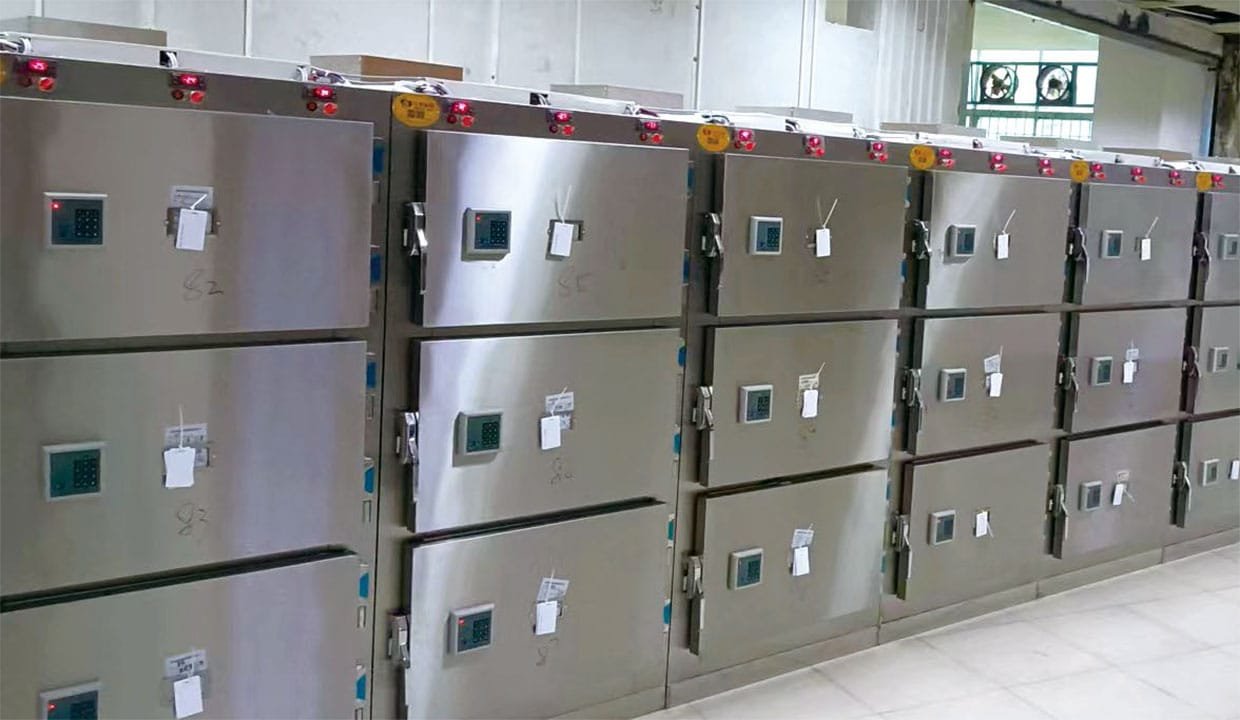
Upright Mortuary Refrigerators
- Capacity: typically 2–6 stations, single or multi-tier.
- Best for: low-volume funeral homes, overspill capacity, and facilities where floor area is the binding constraint.
- Trade-off: tight internal access makes loading and unloading a two-person task; shelf positioning is fixed.
Roll-In Refrigerators
- Capacity: 2–4 stations with the tray or trolley rolled directly in.
- Best for: facilities transferring remains frequently between the preparation room and storage, or between buildings.
- Trade-off: requires trolley standardisation across the site. Mismatched trolleys defeat the entire purpose.
Walk-In Mortuary Coolers
- Capacity: roughly 8–50+ stations, depending on room size.
- Best for: high-volume operations, hospital-associated mortuaries, and facilities with multiple access needs (viewing, release, long-term retention).
- Trade-off: energy consumption scales with the room, not the occupancy. An empty walk-in still costs full duty load — a real problem for facilities with volatile intake.
Vault-Style / Dedicated Storage
- Capacity: scalable to very large holds.
- Best for: coronial, forensic, and mass-casualty planning contexts.
- Trade-off: planning permission, structural requirements, and utility redundancy all become significant.
Selection Checklist
| Question | Why it matters |
| What is peak concurrent occupancy, not average? | Sizing to average guarantees under-capacity at exactly the worst moment. |
| Do you need chilled and frozen in the same footprint? | Dual-mode rooms or separate units — decide before ordering, not after. |
| How many staff, and what safe-handling equipment is available? | Uprights that one person cannot load become de facto single-person lifts. |
| Is there standby power? | A power failure is a temperature excursion with an unknown duration. |
| What alarm and logging system is included, and what is optional? | Retrofitting monitoring costs more and often ends up undocumented. |
| What is the measured duty cycle at part-load? | Determines the real running cost, not the nameplate figure. |
Temperature Monitoring and Record-Keeping
A thermometer tells you the temperature now. A monitoring system tells you what the temperature was at 03:00 on a Sunday, and proves it. Only the second one survives an inspection.
What a Defensible System Includes
- Calibrated digital sensors in every compartment or zone — not a single probe read once per shift.
- Continuous or high-frequency logging. Data-logger practice in the sector uses 5–15 minute intervals. The tighter the interval, the more usable the trend data.
- High and low alarm thresholds, set with intent. Common configurations trip the high alarm at the 40 °F / 4.4 °C band and the low alarm near the freezing point of stored contents.
- Remote notification by SMS, email, or automated call — mandatory where the space is not continuously staffed. HTA guidance specifically requires alarms on refrigerated and frozen units that are tested regularly, with remote alarms where the area is not staffed around the clock.
- A timestamped audit trail that survives a power cut and cannot be silently edited. Digital reporting removes the ambiguity of paper logs, which are only as credible as the handwriting and the pen.
- Calibration records traceable to a recognised reference, with certificates retained.
Why Manual Rounds Are Not Enough
Manual checking is not wrong — it is simply incomplete. Twice-daily rounds leave overnight and weekend windows uncovered, which is precisely when compressor faults, doors left ajar, and power interruptions tend to surface. The documented pattern in the sector is that facilities relying on manual rounds discover failures when someone opens the door, not when the temperature first moved. Each discovery means a longer excursion, greater spoilage exposure, and a gap in the record that must be explained.
Charting for Compliance
Most facilities structure records around a temperature chart per unit, with the set point, accepted range, alarm thresholds, and calibration date recorded in the chart header. Practically, this means:
- Every reading or download interval is attributable to a unit and a time.
- Flag excursions, and link each flag to a corrective-action entry.
- Records are retained for the period the relevant authority requires (commonly stated as a minimum, not a maximum — retain longer if litigation or investigation is plausible).
Common Temperature Excursions: Causes and Responses
An excursion is any deviation outside the accepted range, however brief. The distinction between a minor event and a reportable failure is usually based on duration, not magnitude.
Causes, Ranked by Frequency
| Cause | Typical signature | First check |
| Door left ajar/seal failure | Slow, repeated small rises; worse after loading | Seal condition, closure hardware, staff practice |
| Overloading / blocked airflow | Rise concentrated near the return-air path; uneven zone temps | Store layout, air-gap discipline |
| Condenser coil fouling | Gradual upward drift over weeks; longer run times | Coil condition and cleaning interval |
| Refrigerant undercharge | Progressive loss of capacity; compressor running continuously | Sight glass, line temperatures — contractor task |
| Defrost cycle fault | Cyclic spikes, often overnight | Timer/controller settings, evaporator icing |
| Power interruption | Instant rise, no logging during outage | Standby supply, alarm delivery path |
| Sensor drift or failure | Reading implausible or static while the room feels different | Cross-check with an independent thermometer; calibration record |
| Ambient heat ingress | Seasonal pattern; peaks in summer afternoons | Room ventilation, door traffic, insulation condition |
Response Procedure
The order matters. Work through it in sequence and record each step with a timestamp.
- Confirm the reading is real. Compare against an independent thermometer before acting on a single sensor. A drifting sensor is a common false alarm and a common missed real alarm.
- Protect the contents first. If the excursion is genuine and material, reduce door opening, avoid loading, and prepare to transfer to alternative storage. Contents are irreplaceable; the equipment is not.
- Isolate the cause using the table above. Fix what is fixable in-house (door, seal, blocked airflow, defrost setting).
- Escalate to a contractor for refrigerant, compressor, controller, or electrical faults. Do not open the refrigeration circuit without the relevant certification.
- Notify per policy. Where the excursion is reportable — extended duration, regulatory threshold breach, or affected licensed activity — notify the responsible person or authority as required.
- Document. Timestamp, temperature, duration, cause, action, resolution, and who performed it. Attach the logger download.
- Verify recovery. Confirm the unit returns to the set point and holds it. An excursion that “fixed itself” without an identified cause will recur.
- Correct the root cause. Add the incident to the maintenance schedule and, if human practice was involved, to staff training.
Rule of thumb: any excursion longer than the facility’s own defined tolerance — many operators use 2 hours as the internal definition of a significant event — should trigger a written corrective-action record regardless of the apparent outcome.
Maintenance and Safe Operating Practice
Most excursions are maintenance problems that were visible weeks earlier. The routine below is deliberately staged by frequency.
Daily
- Verify temperature readings against the chart and accepted range.
- Inspect door seals visually and confirm the door is closing fully.
- Confirm the alarm system is armed and the notification path is live.
- Listen and feel for abnormal compressor noise or excessive heat at the unit.
Weekly
- Clean internal surfaces and check the condensate drain is clear.
- Inspect hinges, latches and hardware; lubricate or adjust as specified.
- Confirm standby power is available and, where applicable, tested.
- Walk the storage area for blocked airflow and unauthorised storage.
Monthly
- Clean condenser coils — the single highest-yield maintenance task.
- Check the evaporator for icing and confirm the defrost cycle is completing.
- Test the temperature alarm end to end, including the remote notification.
- Verify refrigerant charge level by sight glass (visual check only; charging is a certified task).
- Review logger data for slow upward drift that individual daily readings would hide.
Annually
- Calibrate or replace temperature sensors; retain certificates.
- Conduct a full door-seal assessment and replace as needed.
- Contractor service of compressor, controller, and refrigeration circuit.
- Review the storage-capacity plan against actual peak occupancy.
Safe Operating Practice
- Never block the airflow path. Overloading is the most common self-inflicted excursion.
- Never leave a unit unsupported. Trays and trolleys must be rated and the load secured before the door closes.
- Follow standard precautions for every handling task — gloves, appropriate PPE, surface decontamination and hand hygiene. Refrigeration changes the rate of decay, not the presence of pathogens. WHO/PAHO interim guidance is explicit that, outside haemorrhagic fevers and cholera, bodies are generally not infectious. However, standard precautions remain the baseline for all handling, and the relevant bloodborne-pathogen regulation still applies to the workplace.
- Keep the storage log legible and up to date. A record written up at the end of the shift is worth less than one written at the time.
- Do not mix regimes on one chart. Chilled and frozen units have different thresholds and different failure modes.
Energy note: well-maintained equipment runs materially more efficiently than neglected equipment — a difference commonly cited at 15–20% — and every degree below the required set point increases consumption further. Setting the controller tighter than the governing standard requires buys no compliance benefit and costs money continuously.
FAQ
What temperature should a mortuary refrigerator be set to?
2–4 °C (36–39 °F) for short-term storage, with a hard ceiling at 40 °F (4.4 °C). Many operators target approximately 3 °C to keep normal cycling safely inside the band rather than skimming the upper limit.
How long can a body be kept refrigerated rather than frozen?
It varies by jurisdiction and purpose. UK HTA guidance directs that, where a body is to be kept beyond 30 days with no immediate release or examination need, it should be frozen (approximately −20 °C). NSW approval to extend storage references 2–5 °C with extensions of 7 or 28 days and longer periods for embalmed remains. Confirm your local rule.
What temperature is used for long-term storage?
Freezing at approximately −20 °C is the figure used in UK licensing guidance. Coronial and forensic retention equipment is commonly specified at −15 °C to −20 °C, and wider ranges of −10 °C to −50 °C appear where longer or more specialised retention is required.
Is 40 °F (4.4 °C) acceptable, or should it be colder?
40 °F (4.4 °C) functions as a statutory ceiling in several US state requirements and as advice in CDC decedent-care guidance. Treat it as the outer limit, not the target. Operating at the ceiling leaves no margin for cycling, door openings, or loading.
What should we do if the temperature goes out of range overnight?
Follow the documented response sequence: confirm the reading with an independent thermometer, protect the contents by minimising door opening and preparing alternative storage, identify and isolate the cause, escalate refrigeration faults to a certified contractor, notify per policy, and create a timestamped corrective-action record with the logger download attached.
Do we need an alarm system if staff are on site during the day?
Where the storage area is not continuously staffed—which includes nights and weekends for most funeral homes—a remote alarm closes the gap. Alarm systems should also be tested on a defined schedule, not assumed to be working.
Is a frozen body still infectious?
WHO/PAHO guidance states that, apart from haemorrhagic fevers and cholera, the bodies of people who have died from infectious disease are generally not infectious. Freezing does not change this. Standard precautions, PPE, and surface decontamination remain the required baseline for all handling, and workplace bloodborne-pathogen rules still apply.
Conclusion and Recommended Next Steps
The compliance case for mortuary refrigeration reduces to a short, verifiable chain: a defined set point, a monitored unit, a documented response, and a maintained system.
What to do next:
- Confirm your governing requirement. Identify whether you are bound by HTA licensing standards, a state or provincial rule, local public-health regulation, or professional practice guidance — and at what temperature and duration.
- Set the controller to the tightest applicable band—normally 2–4 °C (36–39 °F) for chilled storage—and record the number on the unit and in the SOP.
- Audit your monitoring coverage against the hours you are actually staffed, and close the overnight and weekend gaps with logging and remote alerting.
- Write and test the excursion procedure before you need it, including who is called and in what order.
- Put the maintenance routine on a calendar with named owners — daily, weekly, monthly, annual — starting with condenser coil cleaning.
- Review your equipment against peak occupancy, not average, and confirm standby power and alarm coverage on every unit.
Get those six items right, and the temperature stops being a risk you hope holds and becomes a number you can prove.