Dignity. Technology. Sustainability. — Redefining the Afterlife Industry.
Dignity. Technology. Sustainability. — Redefining the Afterlife Industry.
Automatic Ash Discharge Cremation Flue Gas System
The ENTROVITA GH-WQ-FL-12Z takes the proven 1-to-1 purification platform and automates ash removal, so the line keeps running between cremations instead of waiting for a manual clean-out.
- Premium Quality
- Worldwide Shipping
- Best Warranty
Opening Overview
An automatic ash discharge cremation flue gas system removes the one task that ties a crematorium’s staff to the purification line: handling collected fly ash by hand. For busy crematoria, that means fewer interruptions, a cleaner working environment, and less operator exposure to ash residue— with the same certified emission performance and the maintenance burden removed.
What Automatic Ash Discharge Changes for Your Crematorium
On a manually serviced purification line, an operator must remove fly ash captured by the bag filter and the settling chamber at intervals. Each clean-out costs working time, creates dust around the equipment and puts staff in contact with residue that should be handled as little as possible.
The GH-WQ-FL-12Z automates that step. Ash moves out of the collection points without manual intervention, so cleaning cycles no longer dictate your cremation schedule. The practical result is higher usable throughput from the same furnace, more predictable uptime and a simpler safe-handling routine for the team.
How the GH-WQ-FL-12Z Automatic Ash Discharge Line Works
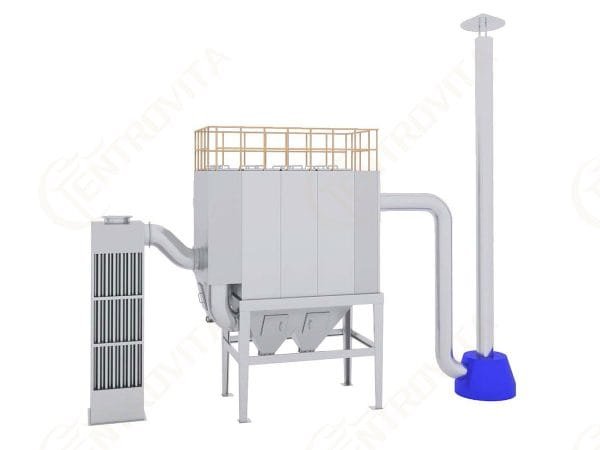
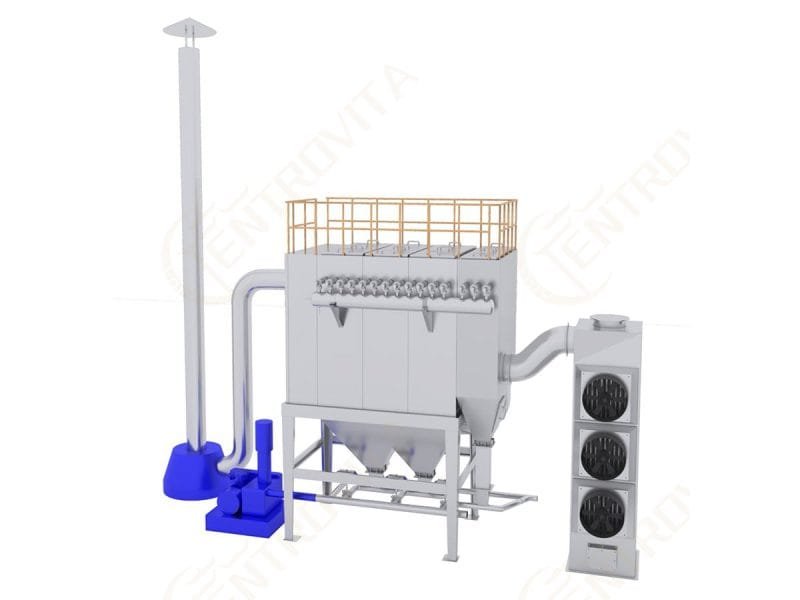
Cremator exhaust enters the line at the flue duct and passes through secondary combustion at 1,000–1,200 °C, which breaks down the harmful compounds remaining in the gas.
Gas above 1,000 °C then enters the quench tower, where air-cooled heat exchange brings it below 200 °C within about two seconds — deliberately passing through, and leaving, the 300–760 °C band where dioxins re-form. The temperature profile makes the process safe, and it is identical on both models.
Downstream, the gas moves through semi-dry de-acidification, activated carbon adsorption and bag filtration, stripping odour, sulphur dioxide (SO2), heavy metals and particulates before the induced draft fan pushes it to the stack. On the Z model, the ash captured in the bag filter and settling chamber discharges automatically rather than accumulating for manual removal.
Core Features and Performance Advantages
Ash handling designed out of the daily routine
Automatic discharge keeps the collection points clear, so operators are not pulled off other work to empty them. Maintenance windows become planned rather than reactive.
Same certified emission performance as the basic model
The Z model shares the full multi-stage treatment train: 1,000–1,200 °C secondary combustion, sub-200 °C quench, calcium hydroxide de-acidification with automatic lime and activated carbon injection, P84 membrane bag filtration and honeycomb activated carbon adsorption. Emissions are designed to perform better than GB 13801-2015.
Dioxin prevention is built into the process
The rapid quench from above 1,000 °C to below 200 °C in roughly two seconds prevents dioxin re-formation instead of relying on downstream capture.
Integrated purification and drying support
The modular purification unit also carries the air compressor set — screw compressor, pressure-vessel-certified receiver, dryer and high-precision filters — so the pneumatic valves and injection systems have a stable, dry air supply built into the package.
Engineered for a decade of service
The purification housing and cooling reactor use 3 mm heat- and corrosion-resistant stainless steel, rated not to be corroded through within 10 years. Cooling tubes use 2.5 mm seamless stainless steel; ducting, valves and fasteners are stainless or aluminium alloy for corrosion resistance.
Compact, modular and quick to assemble
A dedicated ladder and platform set is supplied so the unit can be serviced in place. The line assembles on site from modular sections and occupies comparatively little floor area.
Simple for non-specialist teams
Operating the line does not require specialist technical qualifications, which matters for crematoria running lean staffing.
Applications and Target Users
| Fits well | Why |
| High-throughput single-cremator facilities | Fewer manual clean-outs means less unplanned downtime between services |
| Crematoria with limited maintenance staff | Ash removal is taken out of the daily routine |
| Operators upgrading from a manually cleaned purification line | Same footprint and treatment stages, with automated discharge |
| Facilities where ash handling is a health and safety concern | Reduced operator contact with residue |
| Sites needing a compact, on-site assembled package | Modular sections plus a supplied ladder and platform set |
Not the right fit: facilities that genuinely prefer minimum capital outlay and are comfortable with manual clean-out — the basic GH-WQ-FL-12 remains the lower-cost choice.
GH-WQ-FL-12Z Technical Specifications
The GH-WQ-FL-12Z is built on the same 1-to-1 purification platform as the GH-WQ-FL-12. The platform specification below applies to both models; the ash-discharge assembly is the Z-model-specific element.
| No. | Component | Qty | Technical data |
| 1 | Air-cooled heat exchanger | 1 unit | L962 × W876 × H3100 mm. Insulated reactor takes exhaust below 180 °C within 2 seconds; 3 mm stainless housing (10-year corrosion resistance); 2.5 mm seamless stainless cooling tubes sized to the cremator’s flue gas flow. |
| 2 | Modular quick-assembly flue gas purification unit | 1 set | L3378 × W2205 × H5617 mm. Flame arrest (99% interception), calcium hydroxide de-acidification with automatic activated carbon and lime injection, P84 membrane bag filter (260 °C rated; inlet ≥180 °C / outlet ≥130 °C), ash settling chamber with discharge device, and drawer-type honeycomb activated carbon (100 × 100 × 100 mm). Bypass: 3 pneumatic valve sets, DN400. Aluminium quick-release pulse valves. 1 controller set. 1 air compressor module set. 3 mm stainless housing, 10-year corrosion resistance. |
| 3 | Ladder and platform set | 1 set | Assembled size: L5332 × W2205 × H5617 mm |
| 4 | Flue gas ducting assembly | 1 set | Flanged stainless steel ducting, gasketed and stainless-bolted for airtight joints; 90° welded stainless elbows and tees; stainless expansion-bolt and concrete-cast base; pneumatic valves with automatic switching. |
| 5 | Induced draft fan | 1 unit | High-pressure fan, 18.5 kW motor; furnace pressure held between −450 Pa and −650 Pa with an empty furnace; variable-frequency drive with dedicated inverter. |
| 6 | Exhaust stack (steel pipe) | 1 pc | 3 mm stainless steel; diameter ≥40 cm; height ≥12 m; sampling port at 4 m; 4 mm stainless base. Size: φ450 × 8000 mm. |
| 7 | Automatic ash discharge assembly | 1 set |
Frequently Asked Questions
What does “automatic ash discharge” actually do?
It automates removal of the fly ash collected in the purification unit’s setting chamber and bag-filter section, so the line does not rely on an operator emptying it by hand between cremations. Ask us for the drive, hopper and discharge-cycle details for your configuration — these figures are not yet documented on this page.
Does the Z model treat the exhaust any differently from the basic model?
No. Both share the same treatment train — secondary combustion at 1,000–1,200 °C, quench below 200 °C, calcium hydroxide de-acidification, P84 bag filtration and activated carbon adsorption — and both target emissions better than GB 13801-2015. The difference is how the system removes the collected ash.
Will it reduce how often the line has to be stopped?
That is its purpose. Because ash does not accumulate for manual clean-out, planned maintenance windows replace reactive stops. To confirm the exact reduction, we’d need your cremation throughput, which we can model for you.
What maintenance remains on the Z model?
Activated carbon replacement (drawer-type, approximately every 5,000 cremations), filter bag inspection and the normal pneumatic and instrument checks. The auto-discharge assembly itself should be inspected on the same schedule — the recommended service interval is still to be documented.
Can an existing GH-WQ-FL-12 be upgraded to auto-discharge?
In most cases, the platform is shared, so a retrofit is technically feasible, but it depends on the age and build of the installed unit. Send us the unit’s serial details, and we will confirm.
Next Step: Get a Layout and Quotation
Tell us your cremator details, daily service volume and current ash-handling routine. We will return with a dimensioned layout, the auto-discharge specification, and a full quotation for the GH-WQ-FL-12Z.
Related products

Cremation Flue Gas Purification System
GH-WQ-FL-12